


HuangZhi xiang generally has a distinct aroma. Most varieties have an aroma similar to that of gardenia. The leaves are relatively flat and long. The tea soup is thick and hard. The varieties grown on Fenghuang Mountain have a larger yield and a more distinct grade. People who like it are advised to start with the lowest grade to understand the differences in quality and excellence of HuangZhixiang.
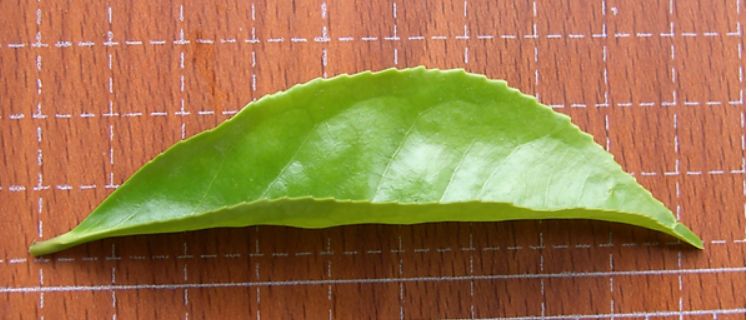
Huangzhi Xiang type representative
1.Song Tea (宋茶)
The tea garden in Li Zaiping Village of Wudong District, which is located on a hill sloping from southwest to northeast at an altitude of 1,150 meters, has been passed down from the villagers Li since the end of the Southern Song Dynasty. Hence, it is named this way. This tree is unique in its variety, fragrance, age, and its name has also changed over time. Initially, because its leaf shape resembled that of a tree leaf, it was called “tuan leaf tea(团树叶)”. Later, through the meticulous cultivation by the Li family, the leaf shape became slightly more elliptical and larger than those of other similar teas. It was then called “big leaf fragrant tea”. In 1946, an overseas businessman from Fuhuang opened a tea shop in Annam (now known as Vietnam) and sold this single-variety tea. Due to its rare growing environment and unique aroma, it was named “Rock Top Treasure” by the businessman. In 1956, after the Wudong Village Production Cooperative carefully roasted and processed it, after careful tasting, it was perceived to have the aroma of orange blossom, and it was renamed “Yellow Orange Fragrant Tea”. In 1958, the four master tea makers of Fuhuang Commune took this finished tea to Fujian Wuyi Mountain for exchange. They named it “Song Variety Single Tea”. In 1969, in the spring of the “Cultural Revolution”, it was renamed “Oriental Red”. In 1980, with the rural production system reform, this tea was managed by villager Wen Zhennan, and it was restored to Song Variety Single Tea, which was abbreviated as “Song Tea”. In 1990, due to its high age, high yield, and high economic benefits, it was widely praised as the “Old Tea King”. On October 30 of the same year, representatives from 80 places including 17 provinces attended the national tea quality, high yield, and high benefit experience exchange meeting (in 17 provinces). They viewed this tree and were deeply impressed, saying that it was “the Old Tea King” and deserved this title.
This tree is a sexually reproducing variety. It is 700 years old, with a height of 5.8 meters. The tree has a semi-open posture, and its crown measures 6.5 meters by 6.8 meters, covering an area of 0.066 mu. In the spring of 1963, over 70 kilograms of fresh leaves were harvested and made into 17.8 kilograms of dried tea, which was the highest production in history. The dried tea product of this tree has the characteristics of “four excellences” and is highly popular among people. Therefore, it has become famous both at home and abroad and is truly a treasure of Wudong Mountain.
2.The aroma of Songzong Yellow Tea (宋种黄茶香)
Song Zong Huangcha Xiang Shantong tea gets its name because of its aroma resembling that of yellow tea. It is grown in the upper left part of the tea garden in the Zhongcuo village of Wudong Li Zai Ping, at an altitude of 1160 meters. It is said to have a cultivation history of 600 years and was selected from the natural hybrid descendants of the Fengan Xiangshen group variety by the Li family. It is a sexually reproduced plant. Due to the lack of emphasis on pruning and maintaining the canopy, it allowed to grow freely. Therefore, the tree is upright, with a height of 6.28 meters. It is the tallest tea tree in the Fenghuang tea area today. The tree posture is semi-open, the tree crown is 6×5.3 meters, the ground diameter is 1.3 meters, the lowest branch is 35 centimeters from the ground, the branch density is medium, and the upper branches have a few withered ones. There are two rounds of new shoots each year. The spring tea production is about 5 catties, accounting for more than 80% of the annual production.
3.Big White Leaf (大白叶)
Because the color of the leaves of this tree is slightly greener than those of other tea plants (tea farmers call this color “white”), and the leaf width is also larger, it was named this way.
This tea garden is located behind the庵角村, in Fengxi Management District, at an altitude of over 800 meters. It was passed down from the ancestors of the management household Huang Hexing. It is a sexually reproduced plant. The tree is 4.39 meters tall, with a trunk diameter of 0.96 meters. The tree crown measures 4.63×4.37 meters. The branching density is moderate. The leaves grow obliquely on the stem. The mature leaves are long elliptical in shape, with a length of 12.6 centimeters and a width of 4.8 centimeters. The leaf surface is flat, the leaf color is green, the leaf texture is thick, the teeth are coarse, shallow and blunt, with 24 pairs. The leaf margin is slightly undulating, and the veins are distinct, with 9 pairs. Usually, the new shoots sprout in three rounds in spring. The spring tea accounts for 60% of the annual production, and it is processed into about 6 catties of dried tea. The finished tea has an orange blossom aroma, with a rich fragrance, a sweet and refreshing taste, and is highly durable when brewed. It is highly popular and praised by tea drinkers.
4.Song Zong No. 2 (宋种2号)
Song Zong No. 2, also known as Song Zong Zai Single Variety. It is the offspring of the old Song tea large shed single variety (which died in 1928) from Yin Village in Wudong Center. It was named so because of this natural hybridization.
It is located in the tea garden at the back of Fenghuang Dian’an Village, on a hill that slopes from southwest to northeast, with an altitude of 950 meters. This tea tree was the fixed property of Fenghuang Taiping Temple from 1660 to 1952. During the land reform in 1952, it was distributed to poor farmer Huang Yong. From 1958 to 1980, it belonged to the collective of Dian’an Production Team. From 1980 onwards, it was managed by Huang Niangqing. From 1988 to 2000, it was managed by Huang Aiguo. Since 2001, it has been managed by Huang Baoguo.
This tree is a sexually reproducing plant. It is 355 years old, with a height of 5.56 meters. The tree has an open posture and a crown measuring 5.6 meters by 6.5 meters. The main trunk is not obvious after being covered with soil and has six major branches near the ground. The branching density is moderate. The leaves grow in an oblique pattern on the middle part. The leaf shape is long-elliptical, with a length of 7.8 centimeters and a width of 3.7 centimeters. The leaf surface is smooth, with a dark green color and a glossy sheen. The leaf quality is medium. The leaf is flat, with 9 pairs of veins. The leaf tip is blunt, the leaf margin is slightly undulating, and there are 24 pairs of fine, shallow, and blunt leaf teeth. It has a strong bud-forming ability. Spring buds start to sprout in the vernal equinox, and the spring tea picking period is after the Rainy Festival. The bud density is relatively dense, the bud color is light green, and there are a few fine hairs. The new shoot is 12 centimeters long, with 3 to 4 leaves per shoot, a shoot interval of 3 centimeters, and new shoots grow in two rounds each year. The new shoot rest period begins in October. The peak flowering period is in mid-November. The corolla diameter is 3.2 to 3.8 centimeters, with 120 to 130 flowers, and the stigmas are divided into three branches. The fruits usually have two seeds.
Quality characteristics: The leaves are tightly rolled and straight, with a dark brown and lustrous color. It has the aroma of orange blossoms, with a sharp and intense fragrance. The soup color is orange yellow and clear, the taste is rich, fresh and smooth, with a strong mountain flavor that lasts for a long time, and a strong aftertaste.
Due to the strong adaptability and resilience of this strain, Fenghuang Town has vigorously promoted its breeding and cultivation, and currently the yield is quite high.
5.ZongsuoXie Dancong Tea(棕蓑挟单丛)
Zongsuo Xie Dancong Tea, also known as Tongtianxiang, Yidai Tianjiao, and Chairman Mao’s Tea, is a legendary tea.
Legend has it that 150 years ago, a young woman from Yincun Village in Wudong was picking tea when a sudden downpour struck. She used a palm-leaf raincoat to protect her tea basket and the harvested leaves. Back home, she meticulously crafted a Dancong tea with excellent shape, color, aroma, and taste, selling it for a good price. Her skillful craftsmanship earned her praise, and the finished tea and the tea tree were named “Zongsuo Xie” (meaning “covered in palm leaves”). Two years later, her father accidentally caused a fire while drying tea, burning down their property. The tea garden was seized by a wealthy landowner, and the young woman fled due to debts. In 1952, Wen Yongji, a resident of Chudicuo Village in Wudong, received a tea garden and forest allocated to him by the land reform team, which included the “Zongsuo Xie” Dancong tea. In the spring tea season of 1955, he meticulously processed fresh leaves using palm-leaf bundles, producing a tea with an exceptionally rich aroma that wafted into the sky, hence the name “Tongtianxiang” (Fragrance Reaching Heaven). This newly liberated tea farmer said, “When drinking water, one must remember its source. I will not forget the Communist Party and Chairman Mao after my liberation. I want to thank my benefactor, Chairman Mao!” Therefore, he carefully selected and processed two jin (approximately 1 kg) of Tongtianxiang Dancong tea and sent it to the great leader Chairman Mao. These two jin of Phoenix tea miraculously carried their fragrance to the sky, reaching Tiananmen Square and Zhongnanhai, and were presented to Chairman Mao. On December 28, 1955, Yongji Bo received a letter from the Secretariat of the Central Committee of the Communist Party of China, entrusted by Chairman Mao. Therefore, the tea farmers renamed “Tongtianxiang” Dancong tea “Chairman’s Tea.” During the Cultural Revolution, it was called “A Generation of Pride.”
6. “Finding a Needle in the Sea” Dancong Tea(海底捞针单丛)
Due to the superior quality of this tea variety, only a small amount of tea leaves is needed to bring out its unique aroma and flavor during brewing. Therefore, when drinking this tea, the water in the teacup and the small amount of tea leaves are likened to the relationship between the sea and a needle, hence the name.
Growing on the west-facing slope of Dayin Mountain, at an altitude of approximately 800 meters in the tea garden behind Shenya Village in the Fenghuang Management District, this tea variety was introduced from Wudong Mountain by tea farmer Lin Haibiao. It is a sexually propagated plant. This is the second generation of “Finding a Needle in the Sea” Dancong tea from this village. The tree is over 100 years old, 3.9 meters tall, with an upright growth habit, 25 centimeters from the ground, a stem circumference of 58 centimeters, a crown diameter of 2.8 x 2.8 centimeters, and mature leaves that are 10.5 centimeters long and 4.1 centimeters wide, with an oblong shape. New shoots grow in three flushes annually, with spring buds sprouting around the vernal equinox and harvesting around Grain Rain. The spring tea yield is 4 jin (2 catties), of exceptional quality, comparable to the first generation. The first generation of the “Finding Needle in the Sea” single clump was highly praised by the central leaders who came to Shantou during the 10th anniversary celebration of the establishment of the Shantou Special Economic Zone. It is the only single clump of its kind. However, this plant died in 1996, but a certain number of cuttings had been propagated in the early stage, forming the asexual reproduction line of this old clump.
7. Tuan Shu Ye Dan Cong (团树叶单丛)
This tea tree gets its name from its leaves, which resemble the leaves of a round, clustered tree.
It grows in a mountainside tea garden at an altitude of approximately 730 meters in the northwest of Dazhi Mountain. It was cultivated from a single plant selected from the natural hybrid offspring of the Phoenix Narcissus variety, using a short-cutting propagation method. The tree is over 40 years old and is currently managed by Lan Xuemin, a villager from Shiguping She ethnic village. The tree is 3.4 meters tall, with an open crown width of 3.5 x 3.2 meters and a stem circumference of 54 centimeters. It has dense branching, with the lowest branch 7 centimeters above the ground. The leaves are obliquely arranged, 9.6 centimeters long and 4.2 centimeters wide. Mature leaves are elliptical with an acuminate tip, a smooth surface, and a dark green color. The leaves are flat and of medium hardness. There are 9 pairs of lateral veins and 23 pairs of fine, shallow, and sharp serrations. The leaf margins are slightly wavy. The spring buds sprout around the vernal equinox, and the harvesting period is after Grain Rain. It has strong budding ability, producing plump buds and leaves, with a yellowish-green color and no fuzz. A single spring shoot is 9 cm long, with a maximum length of 15.5 cm, bearing 6-9 leaves, and internodes 1.5 cm long. New shoots grow in three flushes annually. It has a unique aroma (commonly known as an oily aroma), highly praised by tea drinkers. Each plant yields approximately 10 jin (5 kg) of dried tea.